Before the Next 911 Call: Dickinson County Brings Healthcare Home

Sometimes preventing the next emergency doesn't start in an emergency room.
Sometimes it starts with a handrail.
Or a medication bottle.
A smoke detector. A safer way to take a shower. A donated wheelchair ramp.
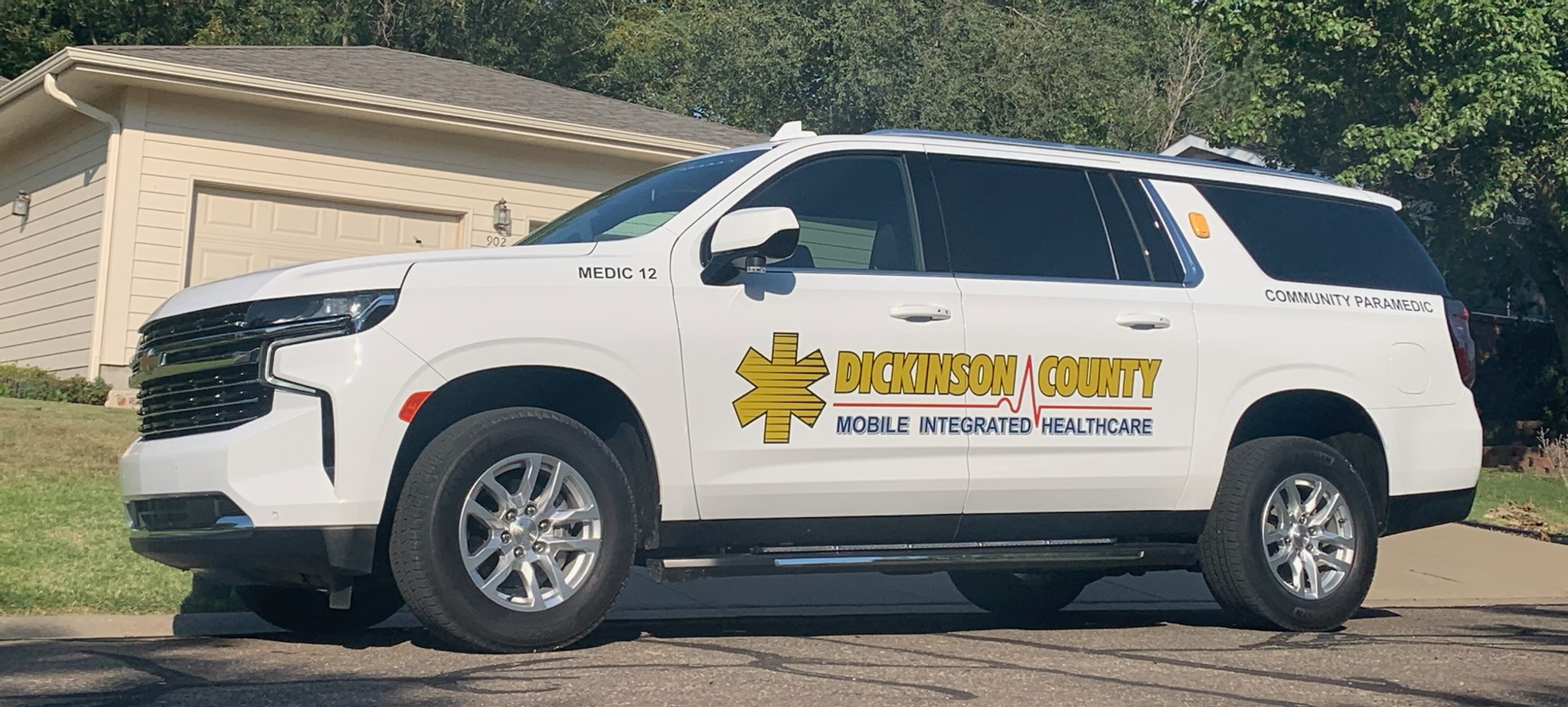
Those are the kinds of solutions Dickinson County's Mobile Integrated Healthcare (MIH)/Community Paramedicine program is bringing directly into homes across the county — addressing health and safety concerns before they become the reason for the next ambulance ride, emergency room visit or hospital stay.
Since seeing its first patient in December 2025, the program has served 28 Dickinson County residents through 257 patient encounters. Twenty-two patients have successfully completed, or "graduated" from, the program.
Behind those numbers are stories of what can happen when healthcare goes beyond the walls of a clinic and meets people where they live.
Bringing Healthcare Home
Dickinson County is one of three rural Kansas communities selected to help pilot community paramedicine in the state.
The Dickinson County program is supported by a three-year, $486,000 grant from the Patterson Family Foundation, which funded a vehicle, equipment, employee training and personnel needed to establish the program.
For Dickinson County EMS and Public Health Director John Hultgren, the concept wasn't entirely new. Community paramedicine had been discussed within the organization years earlier, but the grant created an opportunity to finally put the model into practice.
Getting from concept to a patient's front door took time.
The department had to purchase equipment, train personnel and build the systems necessary to operate the new model of care before seeing its first patient in December 2025.
Today, Dickinson County's Community Paramedicine team includes Capt. Alex Leff, Paramedic, CP; Capt. Jeanne' Schantz, Paramedic, CP; and part-time paramedics Dave Stultz, CP, and Nick Saunto, CP.
These aren't replacements for a patient's doctor, nor are their visits traditional emergency ambulance responses.
Instead, healthcare providers can refer Dickinson County residents to the program for continued support inside their homes.
Brenda Weaver, RN and Deputy Director of Nursing, helps coordinate those referrals and serves as a navigator between providers, patients and the community paramedics making the visits.
And once inside a patient's home, the team can see something healthcare providers often can't: What happens after the patient leaves the doctor's office.
Seeing the Problem Behind the Problem
A prescription may be correct on paper.
At home, the reality can look very different.
Hultgren said the team has found patients taking medications from multiple physicians without realizing there could be conflicts. They've discovered outdated medications, medications obtained online that a provider didn't know about and pills scattered on floors and counters — indications that prescribed medications may not be taken as intended.
Other times, the biggest health risk isn't medicine at all.
Community paramedics evaluate both the patient and the home, looking for fall hazards and other safety concerns that could eventually lead to an emergency.
In one home, the team discovered a resident boiling water on a gas stove to add humidity to the air — and leaving the home while the water continued to boil.
The solution wasn't another medical appointment.
The team connected the resident with resources to get a humidifier.
In another home, the challenge was a shower.
A resident's only shower was in the basement, down a set of stairs Hultgren described as extremely dangerous. Knowing the risk, the resident limited trips downstairs and was only able to shower about once a month.
The MIH team found another solution, adapting the existing upstairs bathtub so the resident could shower without navigating the basement stairs.
It's impossible to know whether that intervention prevented a fall.
But that's part of the challenge — and promise — of preventative care.
The emergency that doesn't happen is difficult to count.
Its impact can still be enormous.
A Ramp, a Family and a Full Night's Sleep
One family's experience demonstrates how far that impact can extend beyond an individual patient.
A Dickinson County resident needed a ramp to safely enter and leave the family's home. The family had looked into having one installed, but the estimated cost was approximately $4,500 — more than they could afford.
A couple of days later, one of Dickinson County's community paramedics walked into Hultgren's office with something he'd spotted on Facebook Marketplace.
Someone in Junction City was giving away approximately 35 feet of accessible ramp.
Hultgren told him to call.
When the owner learned what Dickinson County wanted to do with it, the ramp was donated.
The team traveled to Junction City, dismantled it and brought it back to Dickinson County.
They then worked with the volunteer fire department in the patient's community to install it.
Inside the home, additional handrails were installed along a hallway and in the bathroom.
Those relatively simple modifications changed more than the patient's mobility.
Before the improvements, the patient's father — who was also working — had been waking five or six times during the night to help his son get to the restroom.
After the rails were installed, his son could make the trip independently.
The father later told the team he woke after that first night thinking something must be wrong.
He had slept all night.
The experience meant enough to him that after his son's time in the program ended, he independently wrote to the Dickinson County Commissioners about the program's impact on his family.
It is one example of how an intervention designed for one patient can ripple through an entire household.
A Network of Care
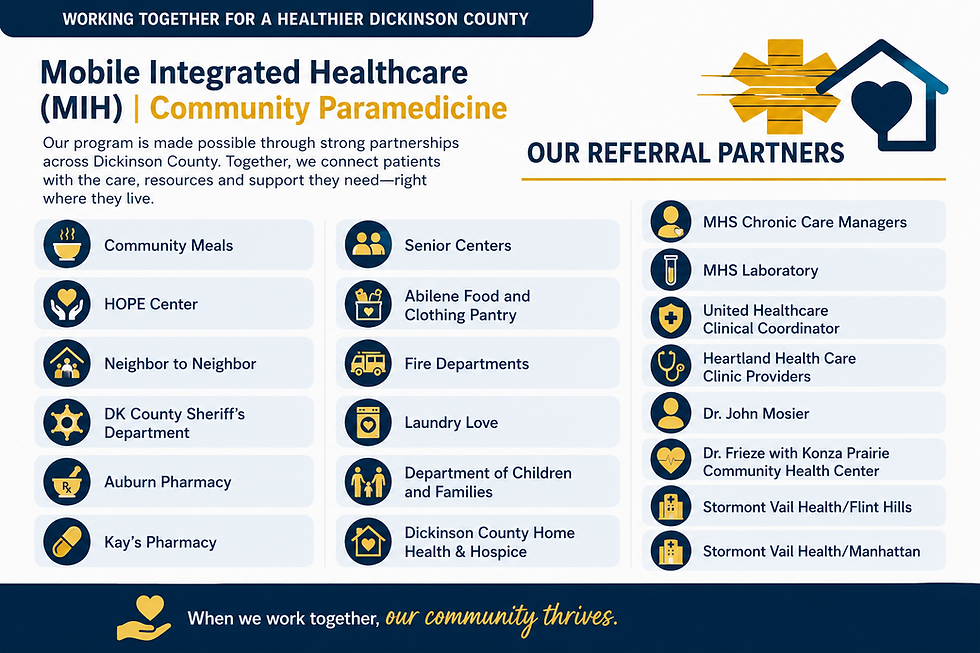
The work also demonstrates that community paramedicine isn't happening in isolation.
Dickinson County's team works with healthcare providers, pharmacies, fire departments, social-service organizations and other community resources to address needs they discover inside patients' homes.
That network includes organizations ranging from Dickinson County Home Health & Hospice, Memorial Health System, Stormont Vail Health and local healthcare providers to Neighbor to Neighbor, the HOPE Center, Community Meals, senior centers, local pharmacies, food assistance programs and area fire departments.
The goal isn't for the community paramedic to solve every problem.
It's to identify what may be standing between a resident and better health — and help connect that person with someone who can.
Dickinson County Helps Lead a Rural Healthcare Model
As one of the state's early rural pilots, Dickinson County isn't simply learning how to operate its own program.
It's helping others learn, too.
Hultgren said officials from several other Kansas counties have contacted him seeking information about starting programs of their own.
He recently presented Dickinson County's experience at the Kansas EMS Association Conference and is scheduled to speak about community paramedicine later this year at the Kansas Association of Counties Conference in Wichita.
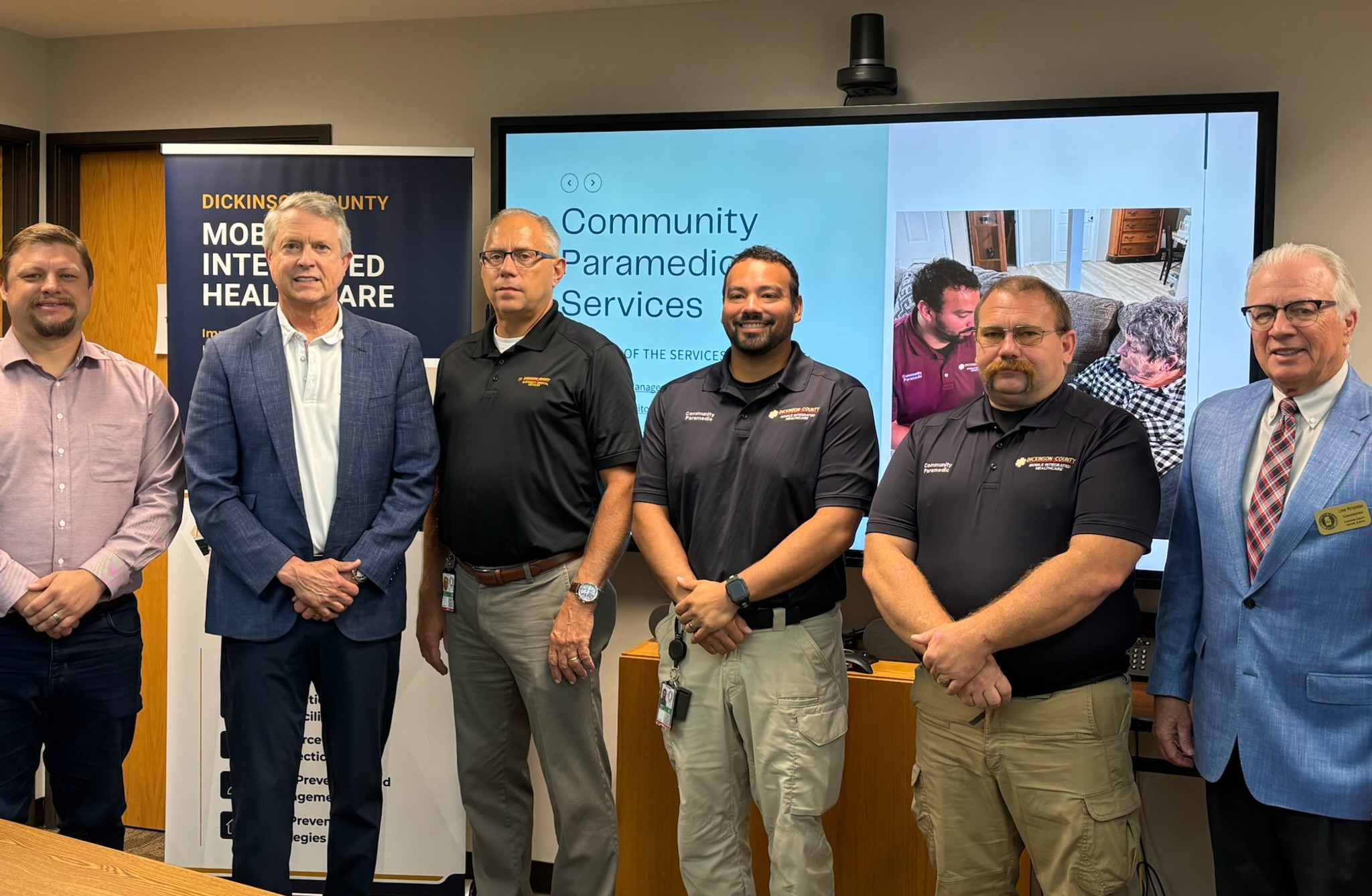
The program is also attracting attention at the federal level. On Aug. 11, U.S. Sen. Roger Marshall and three members of his staff visited Dickinson County EMS specifically to learn about the Community Paramedicine/MIH program.
During the approximately hour-long visit, Hultgren and the team presented an overview of the program and answered Marshall's questions about the work underway in Dickinson County.
The growing interest puts Dickinson County in an unusual position for a rural community: not simply adopting an established healthcare model, but helping demonstrate how it can work in
rural Kansas.
"We knew what would come with that is us then having to be the cheerleader for the program," Hultgren said.
What Happens When the Grant Ends?
As the program gains momentum, Dickinson County is also confronting a much bigger question: How does a program designed to prevent emergencies prove the financial value of emergencies that never happen?
The $486,000 Patterson Family Foundation grant was designed to establish and operate the program for three years — not fund it indefinitely. Hultgren said current projections indicate Medicaid reimbursement could eventually cover approximately 20 to 30 percent of the program's cost. Where the remainder comes from is less certain.
Potential sources could include private insurance reimbursement, Medicare and county funding, but the long-term funding model is still developing. That makes sustainability one of the program's next major challenges. For Hultgren, the possibility of losing the program isn't theoretical anymore.
After watching community paramedics solve medication problems, reduce risks inside homes, connect residents with resources and give families greater independence, he knows what would disappear with it.
"That's the thing I'm most scared of," Hultgren said, "seeing all the good we're doing and then have to say that we've got to close it."
There are still outcomes to measure and funding questions to answer.
But inside homes throughout Dickinson County, the pilot is already providing another measure of its value.
A safer staircase.
The right medication.
A ramp where there wasn't one before.
A patient who can get to the bathroom independently.
A father who can sleep through the night.
And, perhaps, an ambulance ride that never has to happen.
See the Program Up Close at Morning Drive
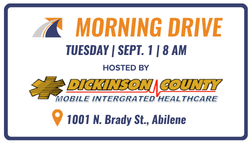
Community members will have an opportunity to learn more and tour the Mobile Integrated Healthcare emergency vehicle when Dickinson County EMS/Public Health hosts Driving Dickinson County's next Morning Drive from 8–9 a.m. Tuesday, Sept. 1, at 1001 Brady Street in Abilene.
Morning Drive is Driving Dickinson County's monthly countywide, drop-in networking event, bringing together business owners, community leaders and residents at a different host location each month.
The September stop offers an opportunity to meet the people behind the program and learn more about an innovative rural healthcare model being developed right here in Dickinson County.
Because sometimes the best emergency response is helping prevent the emergency in the first place.


Comments